
Publications
Evaluation of Approaching-Strategies of Temporarily Required Virtual Assistants in Immersive Environments
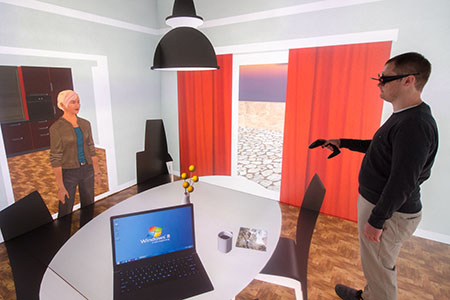
Embodied, virtual agents provide users assistance in agent-based support systems. To this end, two closely linked factors have to be considered for the agents’ behavioral design: their presence time (PT), i.e., the time in which the agents are visible, and the approaching time (AT), i.e., the time span between the user’s calling for an agent and the agent’s actual availability.
This work focuses on human-like assistants that are embedded in immersive scenes but that are required only temporarily. To the best of our knowledge, guidelines for a suitable trade-off between PT and AT of these assistants do not yet exist. We address this gap by presenting the results of a controlled within-subjects study in a CAVE. While keeping a low PT so that the agent is not perceived as annoying, three strategies affecting the AT, namely fading, walking, and running, are evaluated by 40 subjects. The results indicate no clear preference for either behavior. Instead, the necessity of a better trade-off between a low AT and an agent’s realistic behavior is demonstrated.
@InProceedings{Boensch2017b,
Title = {Evaluation of Approaching-Strategies of Temporarily Required Virtual Assistants in Immersive Environments},
Author = {Andrea B\"{o}nsch and Tom Vierjahn and Torsten W. Kuhlen},
Booktitle = {IEEE Symposium on 3D User Interfaces},
Year = {2017},
Pages = {69-72}
}
Turning Anonymous Members of a Multiagent System into Individuals
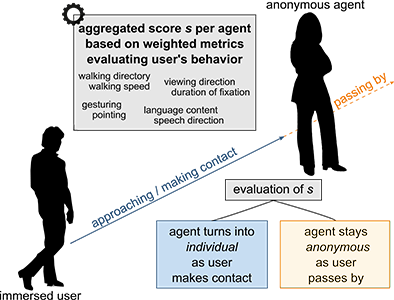
It is increasingly common to embed embodied, human-like, virtual agents into immersive virtual environments for either of the two use cases: (1) populating architectural scenes as anonymous members of a crowd and (2) meeting or supporting users as individual, intelligent and conversational agents. However, the new trend towards intelligent cyber physical systems inherently combines both use cases. Thus, we argue for the necessity of multiagent systems consisting of anonymous and autonomous agents, who temporarily turn into intelligent individuals. Besides purely enlivening the scene, each agent can thus be engaged into a situation-dependent interaction by the user, e.g., into a conversation or a joint task. To this end, we devise components for an agent’s behavioral design modeling the transition between an anonymous and an individual agent when a user approaches.
@InProceedings{Boensch2017c,
Title = {{Turning Anonymous Members of a Multiagent System into Individuals}},
Author = {Andrea B\"{o}nsch, Tom Vierjahn, Ari Shapiro and Torsten W. Kuhlen},
Booktitle = {IEEE Virtual Humans and Crowds for Immersive Environments},
Year = {2017},
Keywords = {Virtual Humans; Virtual Reality; Intelligent Agents; Mutliagent System},
DOI ={ 10.1109/VHCIE.2017.7935620}
Owner = {ab280112},
Timestamp = {2017.02.28}
}
Poster: Score-Based Recommendation for Efficiently Selecting Individual Virtual Agents in Multi-Agent Systems
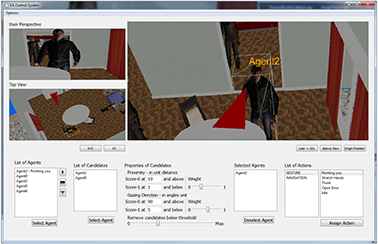
Controlling user-agent-interactions by means of an external operator includes selecting the virtual interaction partners fast and faultlessly. However, especially in immersive scenes with a large number of potential partners, this task is non-trivial.
Thus, we present a score-based recommendation system supporting an operator in the selection task. Agents are recommended as potential partners based on two parameters: the user’s distance to the agents and the user’s gazing direction. An additional graphical user interface (GUI) provides elements for configuring the system and for applying actions to those agents which the operator has confirmed as interaction partners.
@InProceedings{Boensch2017d,
Title = {Score-Based Recommendation for Efficiently Selecting Individual
Virtual Agents in Multi-Agent Systems},
Author = {Andrea Bönsch and Robert Trisnadi and Jonathan Wendt and Tom Vierjahn, and Torsten
W. Kuhlen},
Booktitle = {Proceedings of 23rd ACM
Symposium on Virtual Reality Software and Technology},
Year = {2017},
Pages = {tba},
DOI={10.1145/3139131.3141215}
}
Poster: Peers At Work: Economic Real-Effort Experiments In The Presence of Virtual Co-Workers
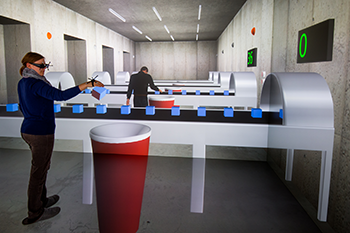
Traditionally, experimental economics uses controlled and incentivized field and lab experiments to analyze economic behavior. However, investigating peer effects in the classic settings is challenging due to the reflection problem: Who is influencing whom?
To overcome this, we enlarge the methodological toolbox of these experiments by means of Virtual Reality. After introducing and validating a real-effort sorting task, we embed a virtual agent as peer of a human subject, who independently performs an identical sorting task. We conducted two experiments investigating (a) the subject’s productivity adjustment due to peer effects and (b) the incentive effects on competition. Our results indicate a great potential for Virtual-Reality-based economic experiments.
@InProceedings{Boensch2017a,
Title = {Peers At Work: Economic Real-Effort Experiments In The Presence of Virtual Co-Workers},
Author = {Andrea B\"{o}nsch and Jonathan Wendt and Heiko Overath and Özgür Gürerk and Christine Harbring and Christian Grund and Thomas Kittsteiner and Torsten W. Kuhlen},
Booktitle = {IEEE Virtual Reality Conference Poster Proceedings},
Year = {2017},
Pages = {301-302},
DOI = {10.1109/VR.2017.7892296}
}
Do Not Invade: A Virtual-Reality-Framework to Study Personal Space
The bachelor thesis’ aim was to develop a framework allowing to design and conduct virtual-reality-based user studies gaining insight into the concept of personal space.
@Article{Schnathmeier2017,
Title = {Do Not Invade: A Virtual-Reality-Framework to Study Personal Space},
Author = {Jan Schnathmeier and Heiko Overath and Sina Radke and Andrea B\"{o}nsch and Ute Habel and Torsten W. Kuhlen},
Journal = {{V}irtuelle und {E}rweiterte {R}ealit\"at, 14. {W}orkshop der {GI}-{F}achgruppe {VR}/{AR}},
Year = {2017},
Pages = {203-204},
ISBN = {978-3-8440-5606-8}
Publisher = {Shaker Verlag}
}
Previous Year (2016)
